Payweave
Overview
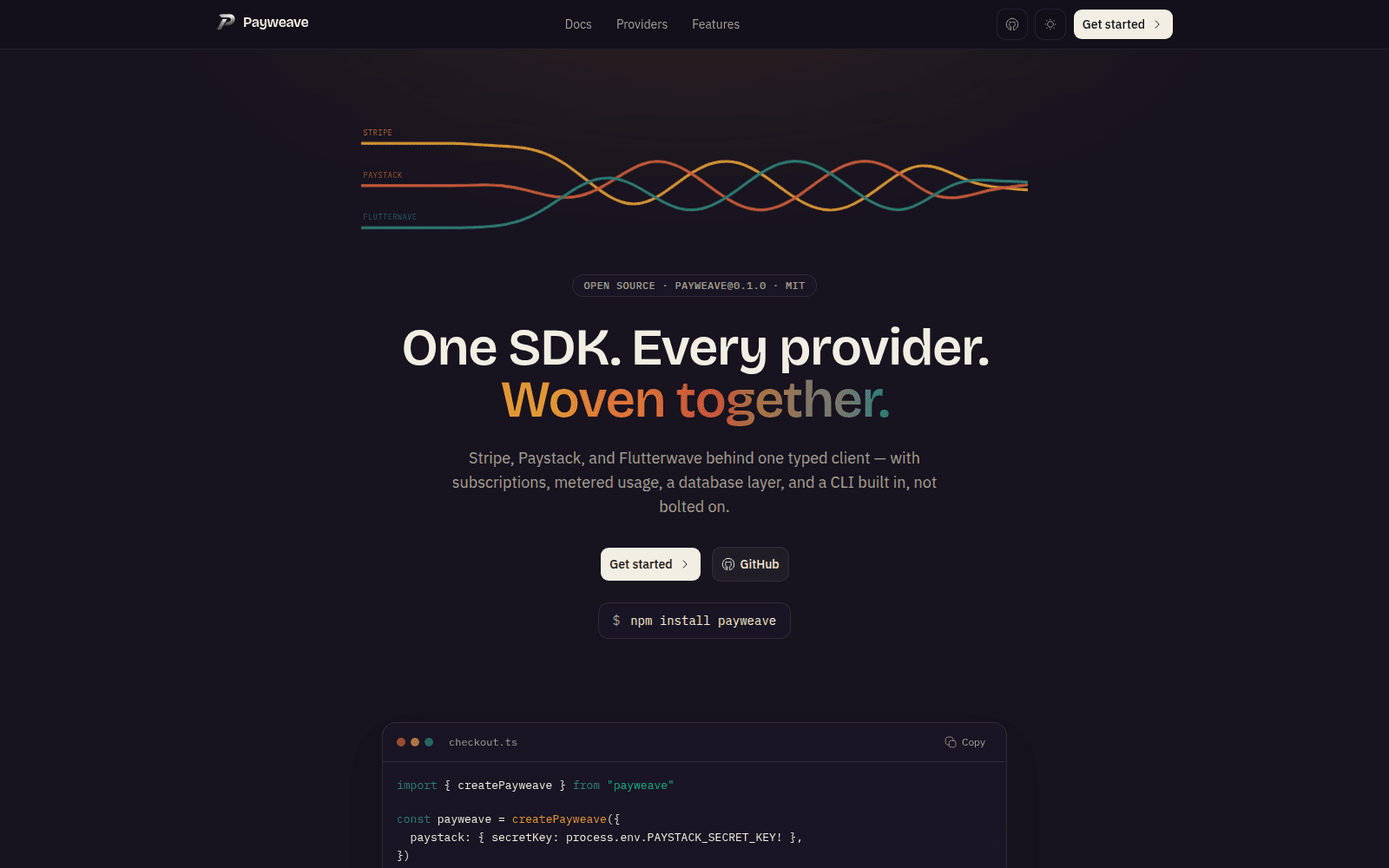
Payweave is an open-source, fully-typed TypeScript SDK that unifies Stripe, Paystack, and Flutterwave behind a single client. It exposes both provider-native calls and a normalized, portable unified layer gated by a typed capability matrix, with first-class webhook security, a database-backed billing layer for subscriptions and metered usage, and a CLI, so integrating a second or third payment provider stops meaning a rewrite of the first integration's assumptions.
My Role
- Creator & Maintainer
Services Provided
- SDK & API Design
- Payments Infrastructure
- Open Source Maintenance
- Developer Tooling (CLI)
My Contributions
- Designed the dual-surface architecture: provider-native calls alongside a normalized unified layer, gated by a typed, queryable capability matrix so unsupported operations fail before any request is sent
- Built compile-time provider narrowing so a client's available namespaces are derived directly from its config, with the same typing extended into the billing layer's plan and feature ids
- Implemented timing-safe, fail-closed webhook verification across four independent signature schemes (Paystack, Flutterwave v3/v4, Stripe) with automatic multi-provider detection from the signature header alone
- Built the billing engine: plans, feature gating, metered usage, and anchor-relative billing-period math, backed by a single database contract with adapters for SQLite, Postgres, MySQL, MongoDB, Drizzle, and Prisma
- Wrote the project's operating constitution and ticket pipeline that AI coding agents implement against, with lint, typecheck, build, tests, and export/type checks gating every merge
- Shipped a CLI (init/push/status/listen), an MSW-backed offline testing toolkit, and the payweave.dev documentation site
Impact
- Replaced provider-specific, hand-rolled payment integrations with a single typed client, closing off a class of money-unit and webhook-signature bugs at the type and architecture level rather than by convention
- Backed by 1,200+ tests across 166 source files, with coverage gates raised specifically on the HTTP client and webhook-verification modules
- Published to npm as an ESM-only package with a single runtime dependency (zod), keeping the install footprint minimal for consumers
- Demonstrated a spec-driven, AI-agent-implemented development workflow held to production-grade rigor in a correctness-sensitive domain
Results
| Industries Served | Fintech & payments infrastructure |
Visit the platform: https://payweave.fynix.dev
npm package: https://www.npmjs.com/package/payweave
Read the deep-dive: Payweave on the blog